精选 新闻
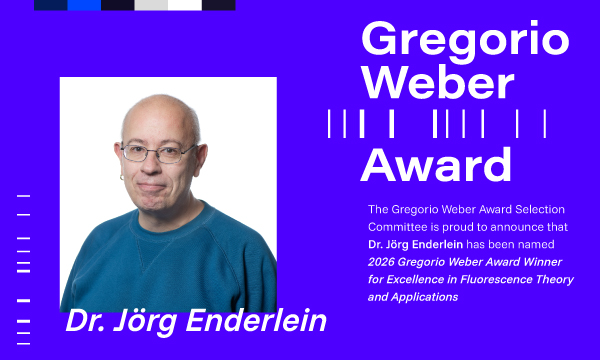
ISS Honors Jörg Enderlein with Gregorio Weber Award
Champaign, Illinois - February 3, 2026 - ISS is proud to announce that Jörg Enderlein has been named 2026 Gregorio Weber Award Winner for Excellence in Fluorescence Theory and Applications
Professor Enderlein is widely regarded as a leading figure in modern biophysics and fluorescence spectroscopy. His pioneering work has deepened scientific understanding of single-molecule fluorescence, super-resolution microscopy, and nano-optics, shaping the trajectory of fluorescence theory and its applications across biology, chemistry, and materials science.
Jörg Enderlein is a distinguished biophysicist whose academic journey began with a degree in physics from Ilya Mechnikov University in Odessa, completed between 1981 and 1986. He subsequently earned his PhD in Physical Chemistry with the highest honors of summa cum laude from Humboldt University Berlin in 1991, followed by his Habilitation in Physical Chemistry at the University of Regensburg in 2000.
His professional career launched in the private sector as a scientific co-worker at PicoQuant GmbH in Berlin from 1991 to 1996, before he transitioned back to academia through a postdoctoral position at Los Alamos National Laboratory in the United States, supported by a DAAD fellowship. Upon returning to Germany, he served as an Assistant Professor at the University of Regensburg until 2000 and then spent five years as a Heisenberg Fellow and group leader at the Research Center Jülich.
Professor Enderlein’s tenure as a Full Professor began at the Eberhard Karls University Tübingen in 2007, where he specialized in Biophysical Chemistry. Since 2008, he has held the position of Full Professor for Biophysics at the Georg August University Göttingen, where he also served as the Executive Director of the III. Institute of Physics – Biophysics. In 2021, he was appointed the founding Editor-in-Chief of Biophysical Reports, a new journal of the Biophysical Society, and served in this role until the end of 2025.
His primary research interests encompass the cutting edge of optical physics and biology, including single-molecule fluorescence spectroscopy, super-resolution fluorescence microscopy, and nano-optics. His work explores complex biological questions such as protein conformational dynamics, folding, and structural biology through the lens of plasmonics. His significant contributions to the field have been recognized by prestigious honors, including a Heisenberg fellowship and the 2021 Advanced Researcher ERC Grant for the project titled smMIET.
Dr. Enderlein joins a distinguished list of past recipients whose work has shaped fluorescence science. The award will be presented at The Biophysical Society Annual Meeting in San Francisco in February 2026.